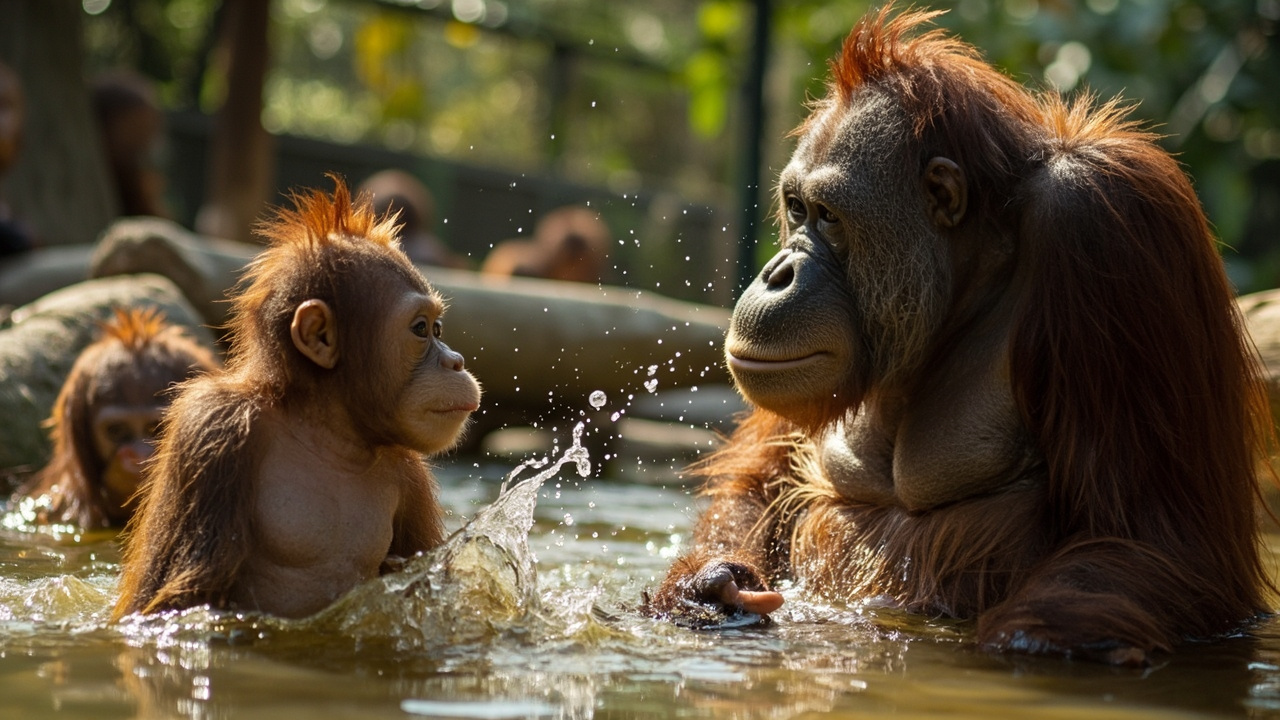
Humans may think they invented comedy. Think again. A fresh batch of research suggests our primate cousins have been running their own comedy routines for centuries — they just never needed an audience.
What Researchers Discovered
A team at the University of California Los Angeles published findings in 2024 that left the scientific community scratching its head. The study suggests some animals don't just stumble into funny situations — they actively seek them out.
To reach this conclusion, researcher Isabelle Laumer and her colleagues analyzed more than 75 hours of footage showing great apes at several zoos. They watched orangutans, chimpanzees, bonobos, and gorillas going about their day-to-day lives. Every single one of these species got caught in the act of teasing their peers.
Eighteen Ways To Annoy A Fellow Ape
The footage revealed 18 different behaviors that qualified as deliberate teasing. The most popular techniques were poking, hitting, blocking another ape's path, full-body slams, and yanking on body parts.
BBC coverage of the findings noted that some apes would wave limbs or objects directly in another ape's face. Orangutans showed a particular fondness for tugging on hair.
Laumer described the behavior as calculated. It was intentional, persistent, and designed to provoke. The teasers would check their victim's reaction and adjust their approach accordingly — almost exactly like human toddlers discovering that poking gets a response.
A typical scenario: a young ape would creep up behind an adult busy grooming a companion. The youngster would then deliver a quick poke or slap to the back. After each jab, the juvenile would freeze and watch. When the adult ignored the provocation, the teaser escalated — sometimes culminating in a full-body slam.
Targets typically brushed off the harassment at first. This only encouraged the pranksters to escalate further.
Man's Best Friend Gets In On It
The ape findings match what University of Colorado professor emeritus Marc Bekoff has documented for years. He and his students tracked social play in dogs and found the animals routinely tease each other.
Unfamiliar dogs engage in this behavior more frequently than those who already know each other. The interactions are often brief — sometimes lasting only five to ten seconds.
According to Bekoff, teasing serves a social function. When one dog wants another to play but faces resistance, a well-placed provocation can shift the dynamic. It establishes ground rules for fair play and mutual consent.
Why This Actually Matters
The humor value for us humans is obvious. Watching a cat refuse to acknowledge a cucumber, or a dog faceplant off a sofa, provides free entertainment. The difference is that these animals have no idea they're making us laugh.
As commentator Tovah Rainsong put it, humans learn to suppress reactions that might embarrass them. Animals lack that filter. A chimp slamming its older sibling delivers the equivalent of a kindergarten prank with zero shame and complete commitment.
That's precisely why animal content dominates social media feeds. No self-awareness means no cancellation risk.
Our Analysis
The scientific community remains cautious. Most evidence for animal humor still leans anecdotal. Large-scale studies are rare. We don't know if apes experience anything like satisfaction when their prank lands. We don't know if dogs feel proud when their tease works.
What we do know is that the behavior looks deliberate. Apes wait for reactions. Dogs time their provocations. Something is happening there beyond pure instinct.
The bigger question is whether this makes animals funnier to us, or simply more relatable. A creature that schemes to annoy its friend is a creature that understands social dynamics. That's closer to us than we'd like to admit.
What To Watch Next
More research is coming. Scientists want to know if teasing skills develop with age, and whether individual apes have signature moves. Dog researchers are similarly investigating whether certain breeds tease more than others.
For now, the takeaway is simple: your pet has probably been running long cons on you since day one.
Key takeaways
- UCLA researchers spent 75+ hours observing great apes teasing each other
- All four great ape species showed intentional teasing behaviors
- Dogs also engage in playful teasing, especially with unfamiliar dogs
- Animal humor is intentional, persistent, and includes checking for reactions
Frequently asked questions
What did the study find?
Researchers found that all four great ape species (orangutans, chimpanzees, bonobos, and gorillas) intentionally tease each other in ways similar to young human children.
What were the most common teasing behaviors?
The top five were poking, hitting, hindering movement, body slamming, and pulling on body parts.
Do dogs also tease each other?
Yes. Studies show dogs love to tease each other, especially unfamiliar dogs, as a way to initiate play and establish social connections.
Why does this matter?
It shows that humor and play are not uniquely human traits. Animals engage in intentional, provocative behavior to get reactions from others—just like people.
Inspired by reporting from: boredpanda.com