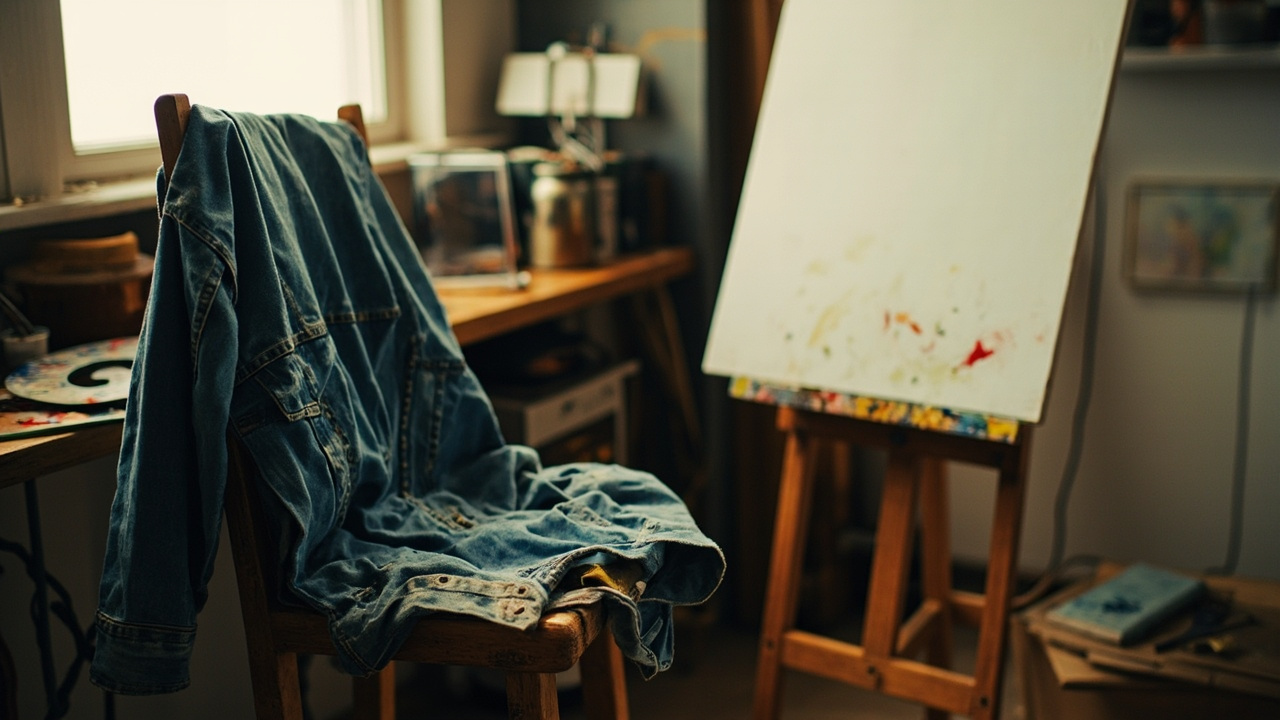
Sometimes the most revealing thing about a person is what they leave behind. A London-based artist has turned that idea into a body of work that feels less like painting and more like detective work. She paints garments without their wearers, and the results are genuinely unsettling in the best possible way.
Hannah Knox works in oil on linen, recreating the tactile details of clothing with an almost obsessive precision. Collars, zips, fur trim, knit patterns, creases, folds — all rendered to look three-dimensional. But there's no one inside these clothes. The bodies are gone. What remains are stand-ins for identity, memory, class, and desire.
The Art Of Looking At What People Leave Behind
Knox doesn't paint clothes randomly. She treats each piece like a portrait session where the subject never shows up. The work draws on her childhood, spent surrounded by her fashion-designer mother's wardrobe. That early immersion in fabric, texture, and what clothing communicates gave her a framework for understanding garments as stand-ins for people.
She calls the finished pieces "portraits without people." A single jacket can suggest an entire life — the status it signals, the memories stitched into its lining, the kind of person who would choose that particular shade of blue. The empty shape holds all that information, waiting for the viewer to fill in the rest.
The technique is demanding. Each crease has to feel earned. Each fold has to tell a version of the truth about whoever last wore the piece. It's not photorealism for its own sake — it's photorealism in service of an idea: that we reveal ourselves through what we wear, and that revelation doesn't require us to be present.
Why Empty Clothes Hit Different
There's something quietly haunting about a painted sweater that no one is wearing. It forces you to imagine the body that gave it shape, the arms that passed through the sleeves, the neck that rested against the collar. Knox leans into that absence deliberately.
According to Knox's own descriptions of her practice, the project began as a way to explore what clothing means when stripped of its wearer. The answer, it turns out, is: quite a lot. A fur coat carries different weight than a T-shirt with a slogan. A carefully pressed collar suggests a different relationship with the world than a wrinkled, lived-in knit.
The paintings invite a kind of slow looking. You study the texture to reconstruct the person. It's an exercise in reading between the lines — or rather, between the threads.
Our Analysis
This work sits at an interesting intersection of art and psychology. On one level, it's a technical showcase — proof that oil paint can do things that photography can't, like emphasizing certain details and smoothing over others in ways that shape how you interpret the garment. On another level, it's a commentary on identity.
We spend so much time thinking about what people wear and what it says about them. Knox removes the person and lets the clothes speak. What's left is both more honest and more mysterious than a traditional portrait would be.
For viewers, the experience depends heavily on their own imagination. Some people will look at a painted jacket and see a specific type of person. Others will see a blank space. Both reactions are the point.
A Concrete Example
Say you're scrolling through your own closet and find a jacket you haven't worn in years. You remember who gave it to you, where you wore it first, and how it felt the last time you put it on. Knox's paintings do that same kind of time travel — but for strangers, with their own forgotten clothes, imagined into existence on canvas.
What To Watch Next
Knox's work is gaining traction in art circles, and "portrait without people" has become a useful shorthand for a certain kind of conceptual painting. Whether this approach spawns a broader trend or remains a niche pursuit depends on whether audiences keep finding meaning in what people leave behind. For now, the empty garments speak loudly enough on their own.
Key takeaways
- Hannah Knox paints empty clothing to explore identity, memory, and what we reveal through fashion choices.
- Working in oil on linen, she renders garments with near-photographic realism while removing the wearer entirely.
- The project transforms clothing into biographical artifacts — each piece suggesting a full life story.
- Viewers fill in the absent person based on their own imagination and assumptions.
- The work raises questions about identity: are we our clothes when our bodies are gone?
Frequently asked questions
Who is the artist behind these empty garment paintings?
Hannah Knox is a London-based painter who works primarily in oil on linen, creating detailed portraits of clothing without their wearers.
What materials does she use for these paintings?
She works in oil paint on linen canvas, building up layers of detail to create textures that appear almost three-dimensional.
What is Knox's artistic background?
She grew up surrounded by fashion — her mother was a fashion designer — which shaped her understanding of clothing as a form of self-expression and identity.
What does Knox call her finished paintings?
She describes them as "portraits without people," treating each garment as if it were a stand-in for its absent wearer.
Where can I see more of her work?
Knox maintains an active presence on Instagram and her official website, where she shares ongoing projects and finished pieces.