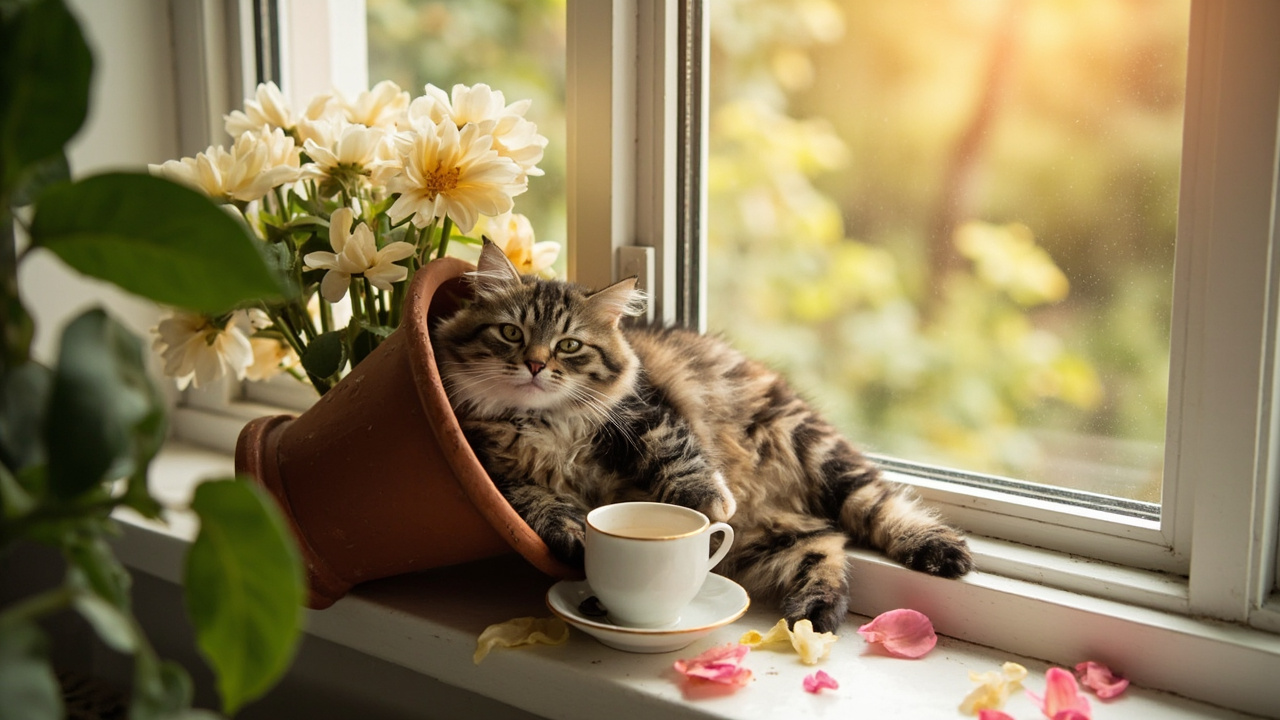
Cats are supposed to be graceful, agile creatures. They land on their feet. They hunt with precision. Their senses put humans to shame. They hear frequencies dogs can't detect, see in near-darkness, and possess reflexes that seem almost supernatural.
And then there's this Twitter account.
"Cats Who Share One Braincell" documents felines who are absolutely trying their best and failing spectacularly. The account has gathered a devoted following precisely because it captures those moments when our supposed perfect predators become absolute disasters. The feed is full of chaos, antics, and deeply relatable cat content that any cat owner will recognize from their own living room.
At a glance
- The Twitter account documents cats being hilariously incompetent at basic tasks
- Despite impressive physical abilities, cats regularly do absurd things
- Posts show cats freezing, going limp, misjudging jumps, and generally being disaster cats
- The account has developed a cult following for its relatable feline content
- The humor works because it contradicts everything we expect from cats
The gap between ability and execution
On paper, cats should be impressive. They need just one-sixth the light humans need to see clearly in darkness. Their hearing range exceeds both human and even dog capabilities. They have a special membrane that lets them blink without affecting their vision, which sounds like something from a sci-fi movie.
But then you see a cat freeze completely when grabbed by the scruff, going completely limp as if its entire operating system just crashed and needs a manual restart. Or a cat that clearly intended to leap onto a counter and instead performed a comedy of errors mid-air, somehow ending up somewhere worse than where it started.
This gap between what cats can do and what they actually do is the entire appeal. They have the hardware for excellence but occasionally run software that seems designed for chaos. The account captures exactly those moments when the hardware and software fail to communicate properly.
Why we love watching them fail
The account's appeal comes from the sharp contrast between expectation and reality. We expect cats to be these competent, almost alien creatures. They act superior, they judge us silently, they give us that look that suggests they know something we don't.
Then they walk into glass doors.
Watching them fail subverts those expectations in the most satisfying way. It's the same reason we enjoy viral videos of people slipping on banana peels or dogs walking into walls. Competence is expected, failure is surprising, and surprise plus relatable embarrassment equals shareable content.
It's also deeply relatable. Most cat owners have stories of their pet dramatically misjudging a jump, getting stuck somewhere absurd, or having absolutely no idea how to solve a problem that seems obvious to any human with functioning brain cells. The account just collects these moments at scale and presents them without commentary, letting the absurdity speak for itself.
The deeper cat reality
Research tells us cats actually do understand pointing and can follow human gazes, but only when it suits them. They learn their owners' faces, voices, and even names of other pets over time. They bring genuine health benefits to households, from reduced stress levels to lower heart attack risk.
But they're also fundamentally weird creatures. Cats enjoy having their own territory free of humans or other cats, yet they tolerate our constant presence because they get bored easily. Over long periods, solitary cats can actually forget how to communicate with other cats properly. Imagine having social skills so cat-specific that you lose them without practice.
The scruff freeze reflex is particularly entertaining. Kittens go limp when mother cat carries them by the scruff, which makes evolutionary sense. Adult cats retain this reflex even though it serves no practical purpose for a five-pound house cat who weighs more than any mother cat ever had to carry. Sometimes cats just freeze and wait for a situation to resolve itself, as if going limp is a valid problem-solving strategy.
Our analysis
Cat content follows predictable patterns—cute kittens, funny accidents, relatable owner moments—but this account carves out a specific niche by focusing purely on failure rather than charm. The best posts capture genuine surprise at cat incompetence.
The format works because it validates cat owners' experiences while providing genuinely funny moments. You're not just laughing at random cats; you're laughing with recognition. "That's exactly what my cat would do" is the mental comment underneath every post.
For readers here looking for mood lifts, this is exactly the kind of content that works. It doesn't ask anything of you, doesn't require following a story, doesn't build tension. It's pure comedic payoff with minimal setup.
What to watch next
Expect more "disaster cat" content as accounts compete for attention in crowded feeds. The format works because it validates cat owners' experiences while providing genuinely funny moments. Watch for accounts trying to replicate this success with similar "failing animal" concepts, though few will match the consistent quality of original disaster cat posts.
Bottom line: The gap between what cats should be and what they actually are makes for consistently funny content. When your pet is simultaneously capable of incredible feats and baffling incompetence, there's always material.
Key takeaways
- Cat content focusing on failure performs well because it subverts expectations
- Most cat owners have relatable stories of feline incompetence
- The contrast between expected grace and actual behavior is inherently funny
- Low-effort, high-reward content fits perfectly into scroll breaks
- Accounts dedicated to specific types of failure attract loyal audiences
Frequently asked questions
What is the "Cats Who Share One Braincell" account?
A Twitter account dedicated to posting photos and videos of cats doing hilariously incompetent things, from failed jumps to getting stuck in ridiculous situations. The account has developed a devoted following for consistently capturing feline dysfunction.
Why do cats sometimes freeze when grabbed?
Cats have a reflex where being grabbed by the scruff causes them to go limp. This is a holdover from kitten behavior when mother cats carried them, but it doesn't always serve adult cats well when humans exploit this "loophole."
Are cats actually as incompetent as this account suggests?
No—cats have genuinely impressive physical abilities. The account just documents the moments when things go wrong, which are funnier precisely because of the contrast with what cats are actually capable of doing.
What makes this cat content so shareable?
Cat owners recognize these situations from their own pets. The humor comes from seeing expectations of feline grace immediately contradicted, then realizing your own cat does the exact same thing.
Why do cats misjudge jumps and movements so often on camera?
Cats usually land on their feet due to a complex reflex involving their flexible spine, but even millions of years of evolution can't prevent occasional miscalculations. The account simply collects evidence of these rare failures rather than the countless successful landings.
Inspired by reporting from: 2.boredpanda.com